ElevenLabs: The question the product won't answer
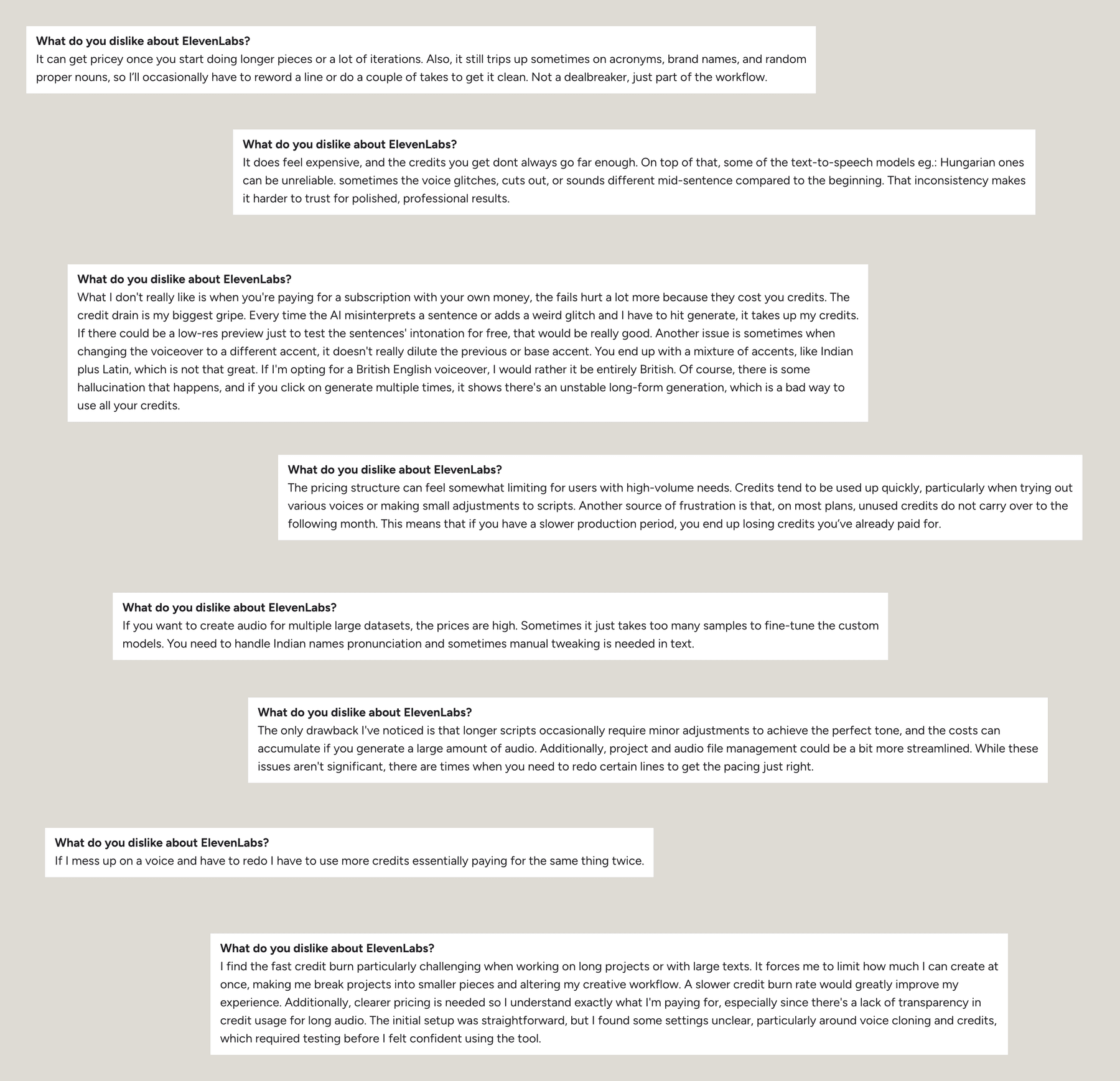
ElevenLabs charges credits for everything it generates. I went looking for how that works, and found the answer in a documentation page, a tooltip, and a setting below the fold. Never on the screen where the spending happens.
What this is
An independent teardown. Self-directed and unpaid. AI audio, pricing.
Analysed
One account, one tier, one day · August 21, 2026
Method
Every tool walked by hand, costs read off the screen and checked against the docs
Independent. Not affiliated with, commissioned by or reviewed by ElevenLabs. One account on one tier over a single day, plus the published documentation, so it may look different further up the plans.
I spent a day trying the different features of ElevenCreative, the platform ElevenLabs builds for people making things, working through Text-to-Speech, Sound Effects, Music, Dubbing, Voice Changer and Studio. Around the third tool I noticed I had been asking the same question at every one of them without getting an answer.
What is this going to cost me?
Part of that is a pricing question. Expensive is the top complaint on G2 reviews as well, 171 mentions, and a share of those reviewers want a cheaper per-character rate for bulk work.
The rest is the product being unable to say what it charges at the moment it charges.
The published price and the real one
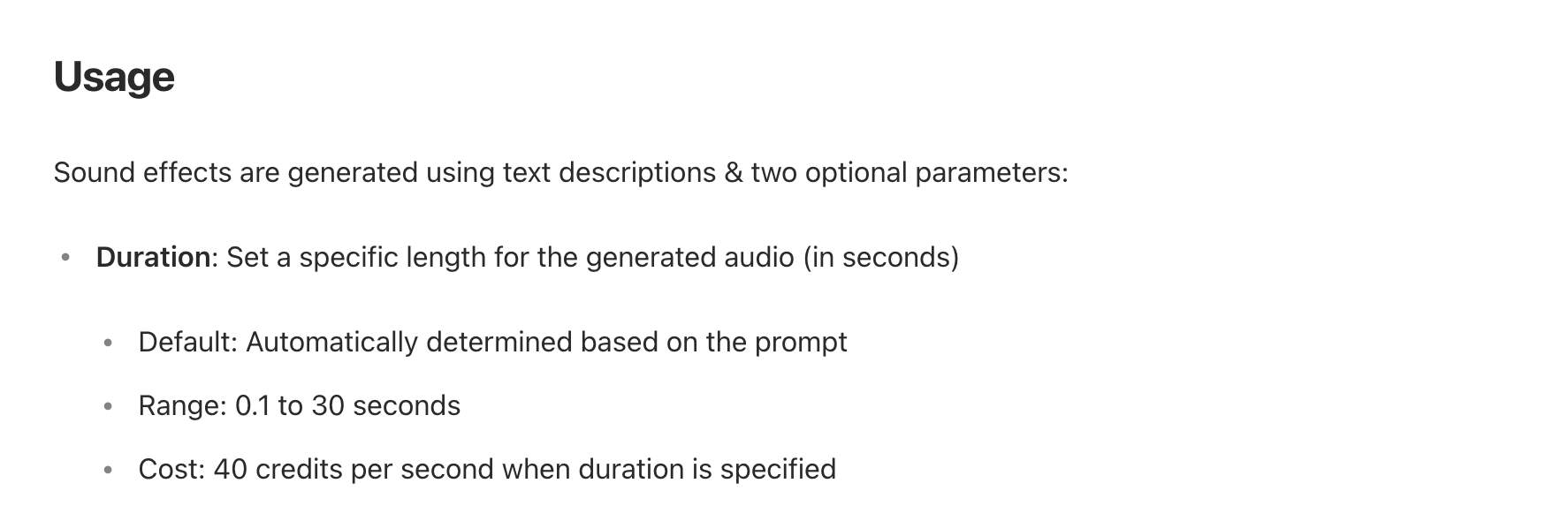
The Sound Effects documentation gives the cost as 40 credits per second when duration is set.
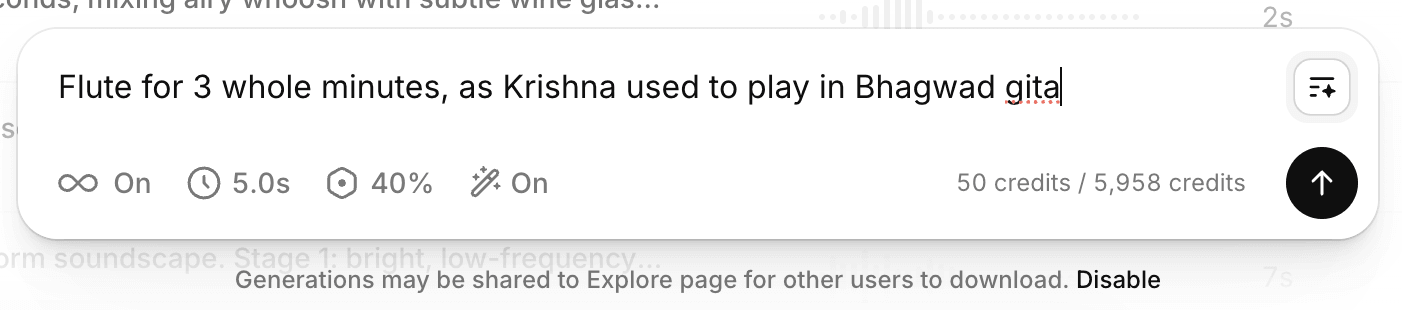
I set it three times.
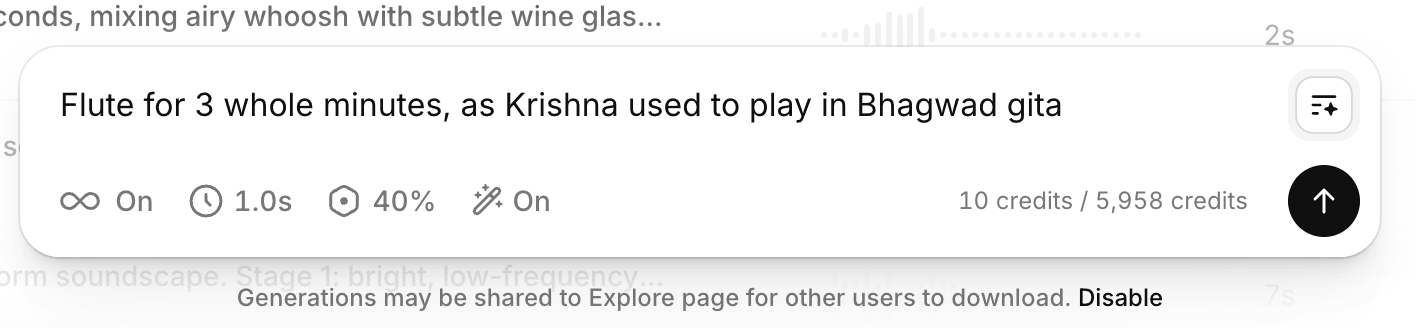
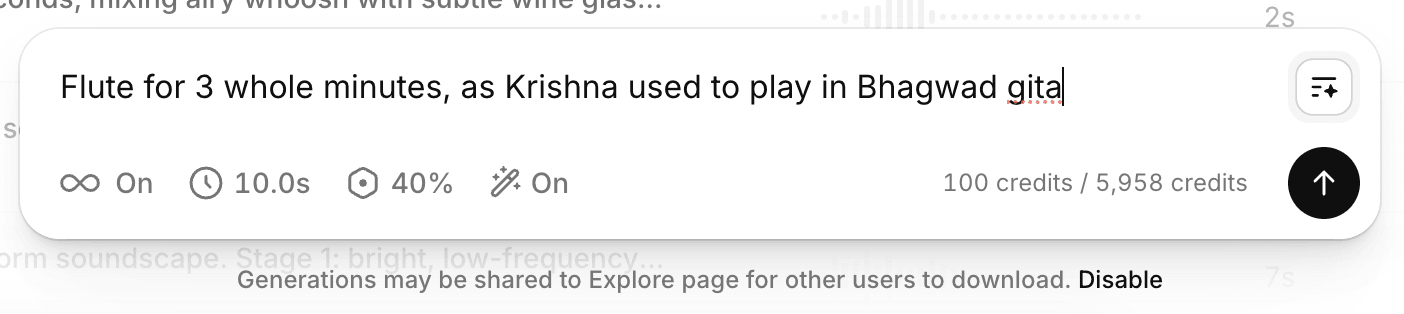
1 second
10
credits quoted
5 seconds
50
credits quoted
10 seconds
100
credits quoted
Ten credits a second. A quarter of the published rate. I can't tell which of the two numbers is wrong, and neither can anyone reading the docs to plan a month of work.
An agent with no ceiling
Studio Agent is labelled Alpha, so I was expecting some surprises. I asked it to add effects to a project. The header read 5,958 credits before I started.
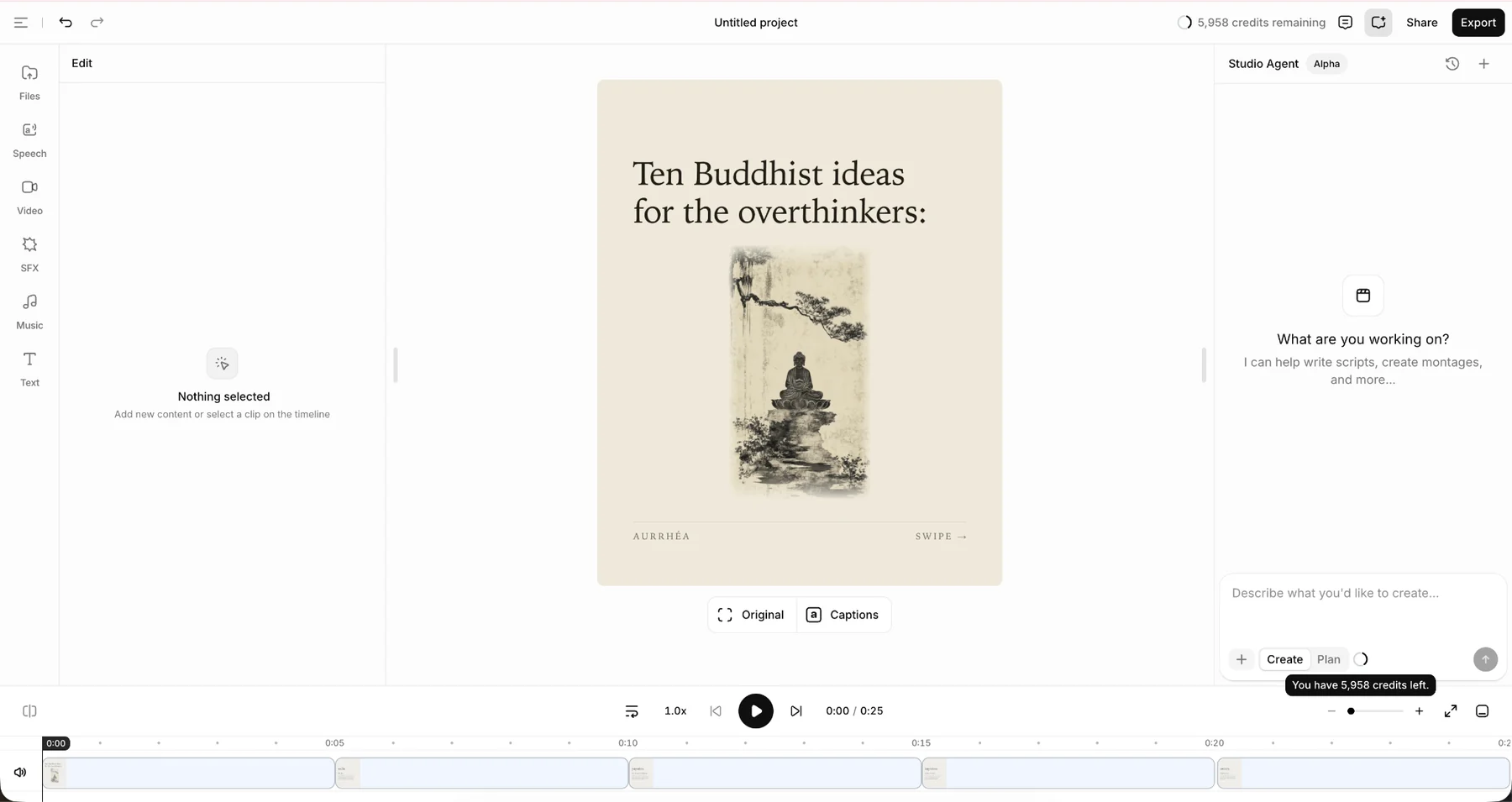
The panel settled on 423 credits used by the agent. The header still read 5,958.
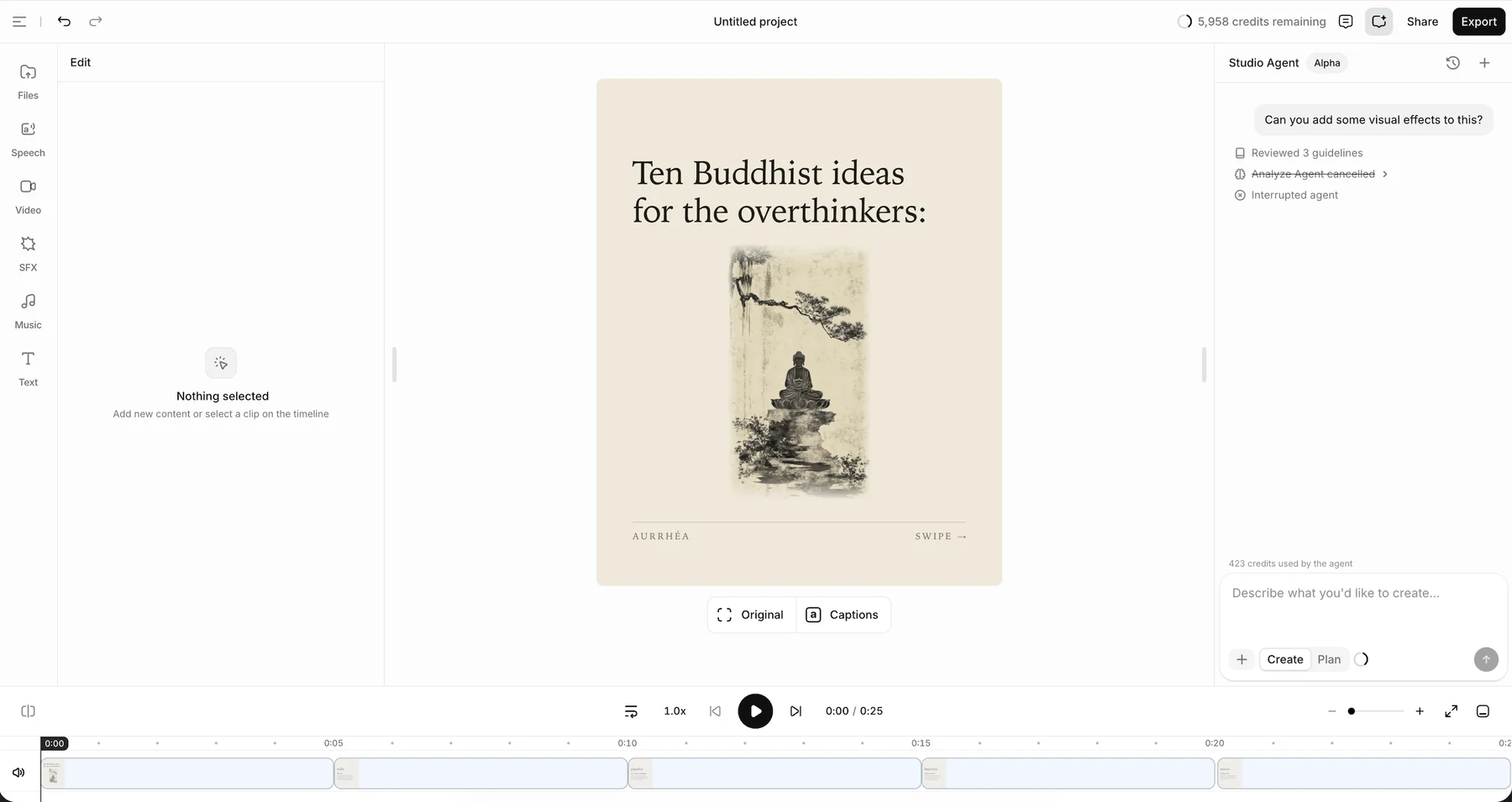
Then the header fell to 5,535. The same 423.
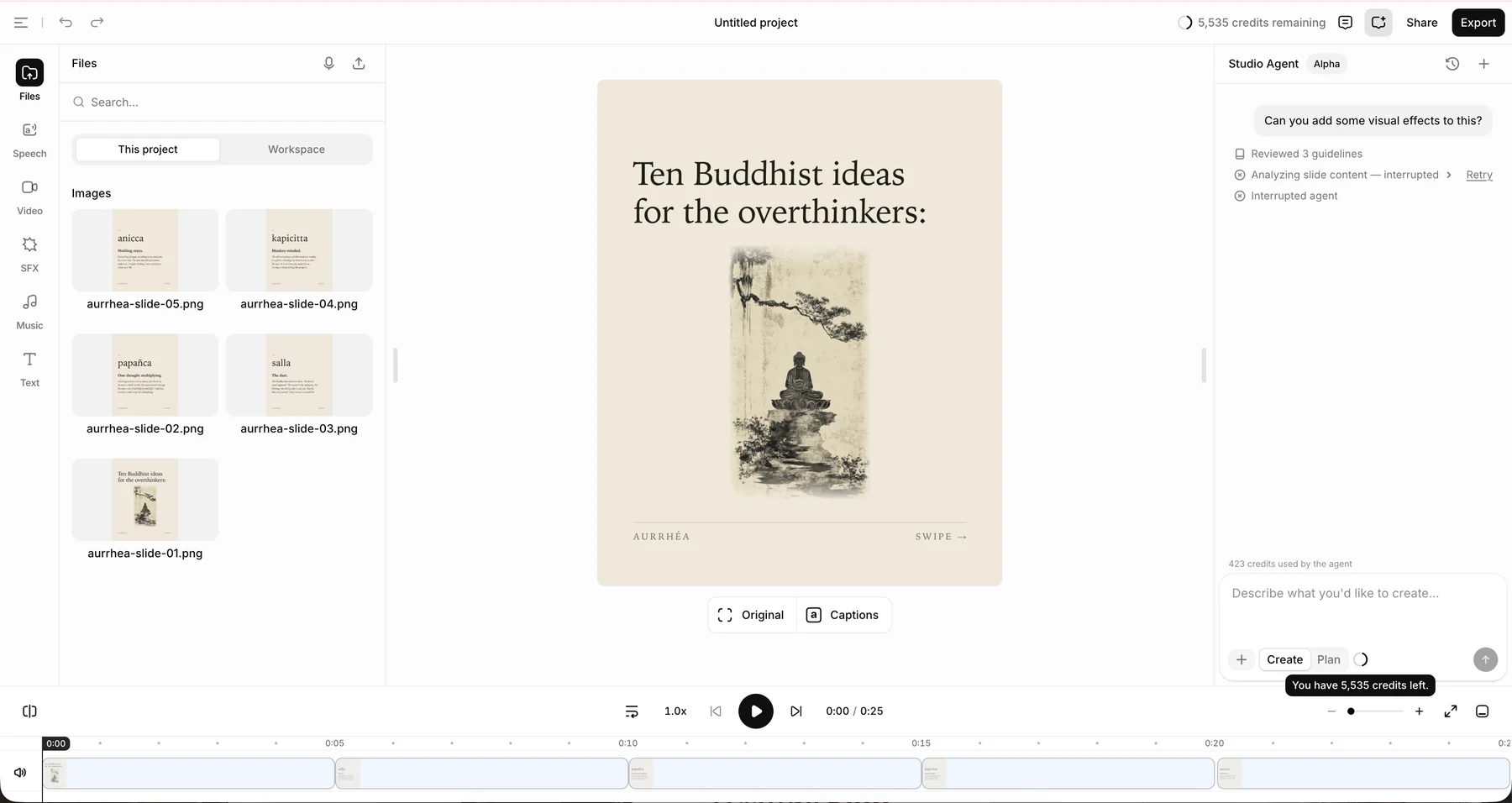
It is not lagging, and it is not wrong. The tooltip explains what it is: Cost of the agent's LLM calls in this conversation. Any generations produced are charged separately.
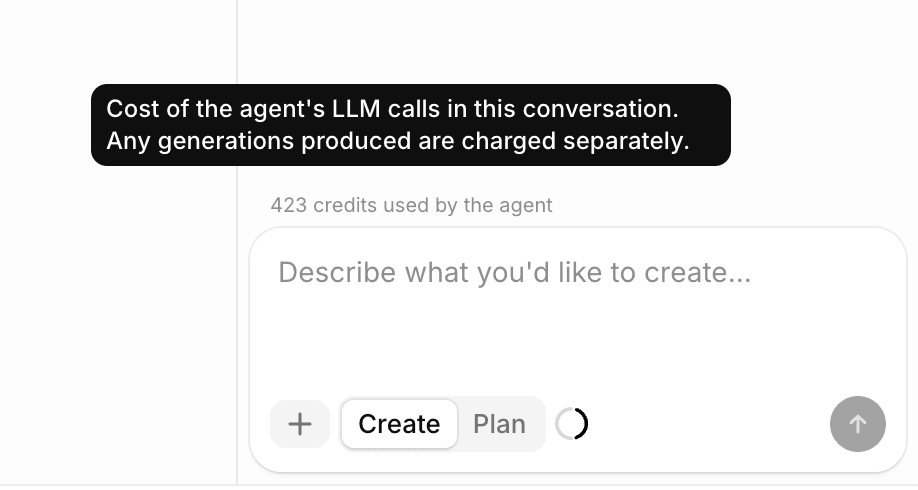
The counter covers the agent's own LLM calls. Anything produced along the way is charged on top of it, and hover is the only place that says so. This run was cancelled early, so there was little to charge. On a run that generated, the two numbers would have parted, and nothing on screen would have said so. While it worked, there was no cap I could set.
Alerts that watch everything except money
Under the Developers section, there's a complete alerting system. Timeline, filters, auto-resolve after inactivity, webhook delivery. The thresholds on offer are conversation failure rate, tool failure rate, webhook error rate, guardrail trigger rate, call initiation error rate.
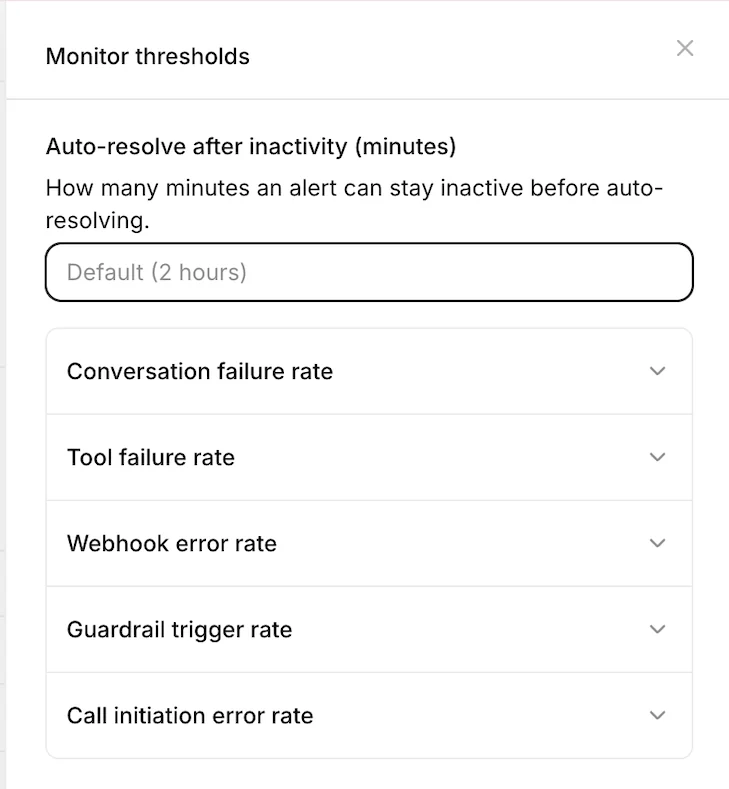
Five thresholds, all of them about agents falling over. None about the spend.
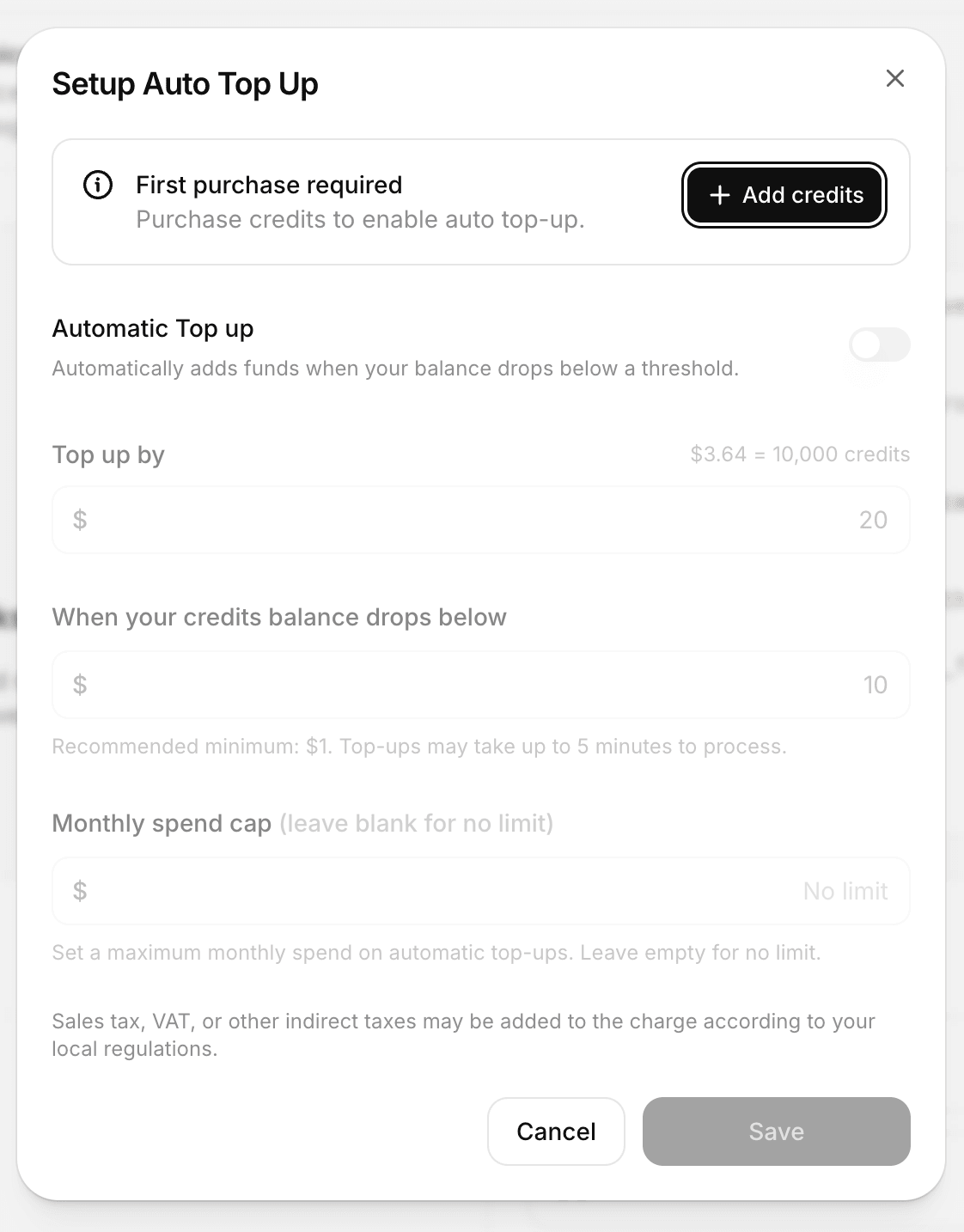
Auto Top Up meanwhile charges a saved card to keep usage uninterrupted, its monthly spend cap is off by default, and it allows up to 250 top-ups a month. A balance can refill itself 250 times with no ceiling unless someone goes looking for the setting, and nothing in the alerting system is watching. I had to check the support documentation, and still had to hunt for the setting: Developers, then Usage, below the fold.
The same problem, already solved next door
Every one of these shipped to agents and the API. None of it reached ElevenCreative.
| Date | Shipped to agents and the API | ElevenCreative |
|---|---|---|
| April 20, 2026 | Credit usage broken down by product, over time. Replaces the old character-stats endpoint | Unavailable |
| May 13, 2026 | Workspace analytics for requests: time ranges, filters, search, sort | Unavailable |
| June 15, 2026 | Timezone-correct usage reporting | Unavailable |
| July 6, 2026 | The cost of each conversation, in US dollars, plus per-category charge, price and usage breakdowns | Unavailable |
| July 13, 2026 | A monthly credit cap you can set for each person you invite | Unavailable |
Source · ElevenLabs changelogs, April to July 2026
Five releases in four months, all on one side of the house.
The July 13 row is the one I keep coming back to. A monthly spend cap exists in this product. It was built for the people a workspace admin invites, not for the person doing the spending. My own top-up cap is off by default.
So the capability is here. It reaches developers who read API reference docs, and not the people writing the reviews.
What I'd change
Not a redesign of any of these screens. One cost contract every surface has to satisfy, rendered differently depending on what it makes.
- What this costs, marked exact when the settings determine it and estimate, up to X when they don't.
- What's left, and when it resets.
- What happens when you can't afford it, since Dubbing currently lets me start a job I can't finish.
- A stop, for anything that spends continuously.
I built it. There is a forty-second walkthrough and a working prototype at the end of this section.
The frames below are drawn on Text-to-Speech, which is where most of the day went. The contract is meant to hold across every tool that spends.
Current design
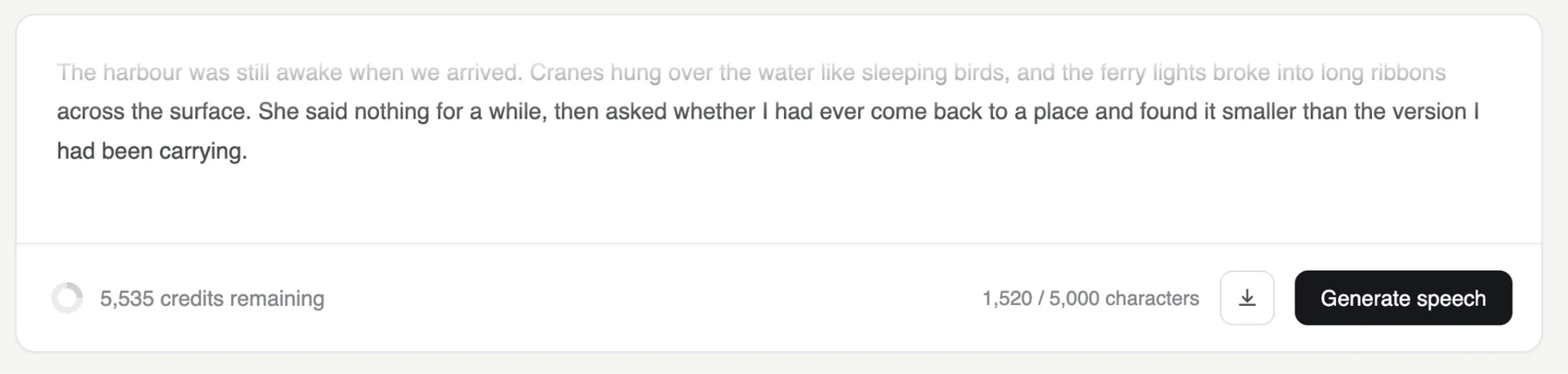
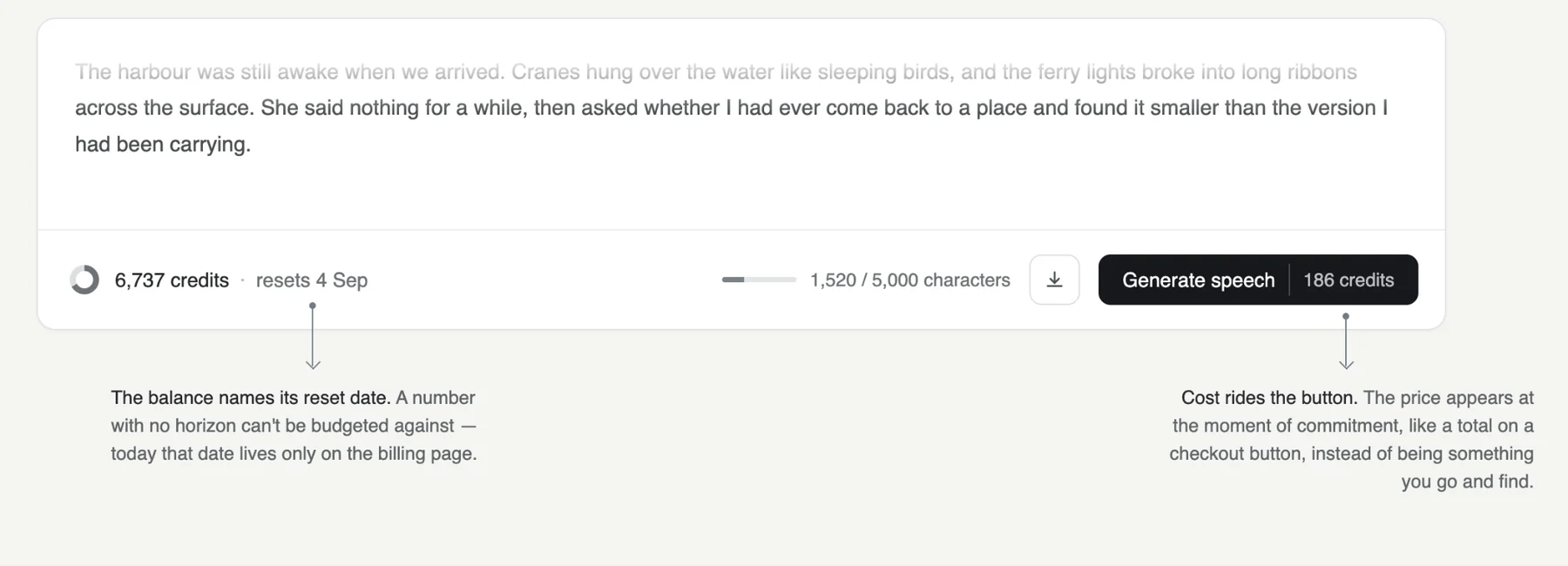
Neither number is on it. The balance does not say when it comes back, and the button does not say what pressing it costs.
Suggested changes
Three, and none of them moves anything that is already on the screen.
The cost, on the commit control itself
On the button, because that's the moment of commitment. Same reason a checkout button carries the total rather than making users go find it.
The reset date, on the balance
A balance with no reset date can't be budgeted against, and today that date only exists on the billing page.
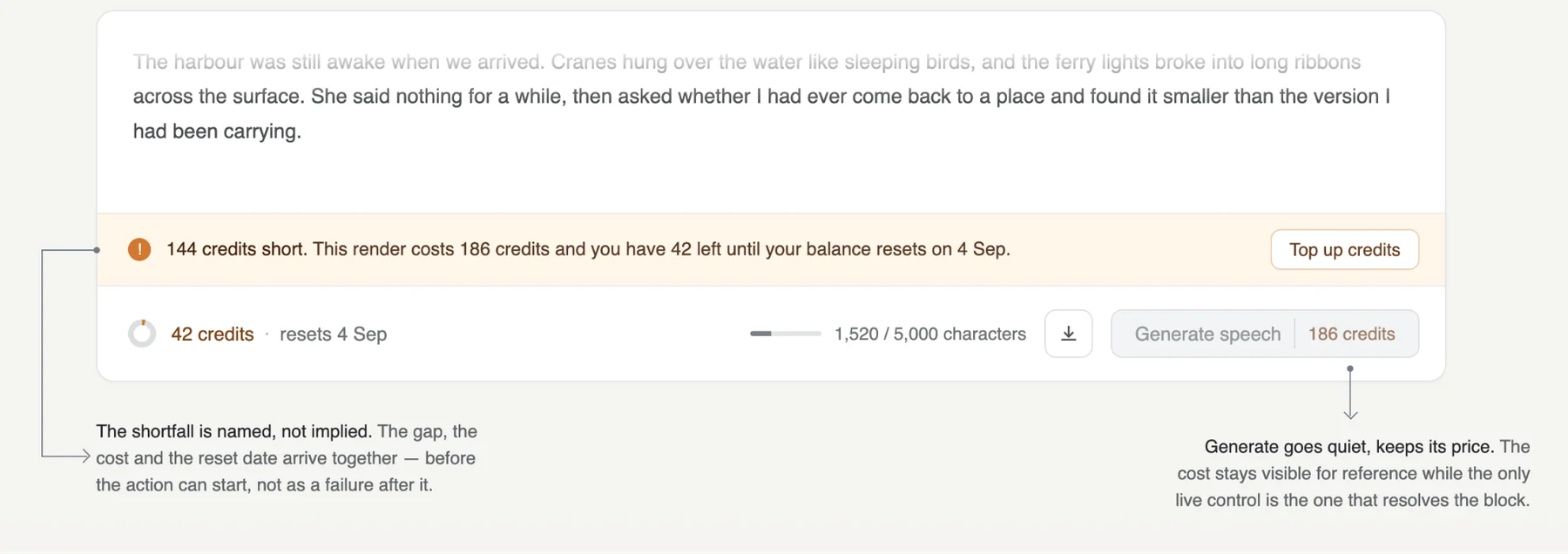
An insufficient-balance state, as a second frame
When the cost exceeds what's left, the bar says so before the action can start, and names the shortfall against the reset date.
Both of these are built
The frames above are stills of a working thing, not drawings of one. Here is the same generation running on both versions of the bar at once, today on the left and the proposal on the right.
Forty seconds, side by side. Open it full screen
Why a better model doesn't fix this
The help centre describes two things ElevenLabs is working on. One is a way to let people preview at full quality without raising prices. The other is making the model controllable enough that nobody needs to preview at all.
Making the model better won't remove the need for the preview.
I wouldn't preview because I distrust the model. I'd preview because I'm the author. I might not like a word. I might cut a line, or add one. That's editing, and editing is the job, not a defect in the pipeline. A better model makes fewer mistakes. It doesn't make me change my mind less often.
18 things went into my notes that day. One was about how the audio sounded.
There are partial answers in the product already. Two free regenerations in Text-to-Speech, and v3 returning two takes for the price of one. Both help with a bad roll of the dice. Neither lets me hear my own words before I pay for them.
Resources
Everything else here is first-party, read off the interface by hand on August 21, 2026.