The break that ends itself
A browser extension that interrupts the drift to a feed, and the four findings that argued against what I'd already built.
Role
Designer, researcher and builder, solo. Product design, research.
Context
Solace, by my own brand Aurrhéa, 2026. Consumer browser extension, live on the Chrome Web Store.
Outcome
Shipped at v0.7.0. 18 decisions audited against 11 papers and 4 product categories, 4 of which argued against it
Before
Every product in this space either blocks you, measures you, or lives on a new tab you only reach once you've already drifted.
After
A card that arrives inside the work you're already doing, blocks nothing, measures nothing, and ends itself.
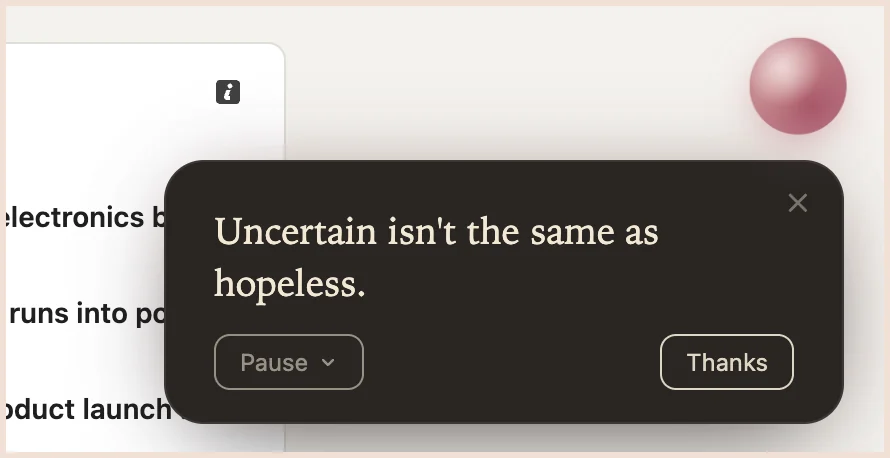
The position nobody was holding: present at the moment of drift, and non-restrictive.
The product
Solace rests a small orb in the corner of the page. A few times a day it blooms a short card inside whatever you're already working on, waits a few seconds, and fades on its own. It never speaks outside the browser: no system notifications, no sound, nothing that follows you out.
It's live on the Chrome Web Store as Solace by Aurrhéa, currently unlisted while the first versions go past real testers.
Why this problem
I built this for a habit of my own, and it isn't the one the category assumes. When the work is tedious, or hard enough to wear me down, my mood drops and I go looking for something that will lift it: a quote, something inspiring, a saved collection I'd called the feel-good board.
All of that lives on Instagram. So I open Instagram to find one good thing, and I'm still there long after I found it, further down than when I started. The instinct was right and the thing I went for was small. It was just kept somewhere designed never to let me leave.
That's an anecdote, though, and one person's anecdote is not a reason to build something. Three things had to be true for it to hold, and I was checking them while the thing was being built, not assuming them, and not waiting until it was finished to find out.
- The behaviour is real and measurable.Doomscrolling has a validated questionnaire behind it and is a distinct pattern, not a synonym for being online too much. Roughly 31% of US adults say they regularly do it: 51% of Gen Z, 46% of millennials.
- The interruption has a known cost.After a task switch, part of your attention stays stuck on the unfinished task and drags down whatever comes next. The effect is worst when the first task was left incomplete under pressure, which is exactly the moment people drift to a feed.
- A brief break genuinely restores attention, but only if it ends.Micro-breaks of ten minutes or less reliably reduce fatigue. An infinite feed is engineered never to end, so it occupies the break slot of the working day while producing the opposite effect.
So the instinct to take a break is right, and so is what the user goes there for. The destination is wrong. That's the whole product in two sentences, and it's also the design constraint: a restorative break needs a built-in ending. A card that appears and dismisses itself has one.
The number I refused to use
Half the products in this space market on the claim that it takes "23 minutes and 15 seconds" to recover from an interruption. I went looking for the study. It traces to a 2006 magazine interview, and an independent check of the papers usually cited as its source found the figure in none of them.
It would have been the most quotable line I had. I left it out and used the peer-reviewed mechanism instead.
The decisions
Six, and I've picked the ones where I gave something up. A decision with no cost attached isn't a decision, it's a description.
Everything stays on the machine.
No account, no server, no telemetry. The one network call in the codebase is currently dormant. This is the most expensive decision in the product and it's worth being precise about why: with no telemetry, I cannot measure anything. Not whether people keep it, not which theme they'd pick, not whether a single card ever landed well. Every question I have about my own product has exactly one honest answer: go and ask people. That constraint is what the study in section 06 is. It isn't a research exercise I chose to run, it's the only instrument I left myself.
The second cost is the permission. Solace asks for access to every site, which is the broadest permission a browser extension can request, and then reads no page content at all. It appends its own element and reads the origin so the orb remembers where you put it. That breadth invites scrutiny at every store review, and I don't intend to concede it, because no narrower scope leaves a working product: being present at the moment of drift means being inside the page you're already on. In a year when hundreds of extensions were caught quietly harvesting browsing history, asking for everything and taking nothing belongs in the listing, not buried in a privacy policy.

No account, no server, no telemetry. Which is also why there has to be a study.
Content is organised by feeling, not by topic.
Lines sit under Stuck, Overwhelmed, Uncertain, Wanting, Hopeful, so choosing one means first naming how you feel. Putting an emotional state into words measurably dampens the brain's threat response, and it does that without feeling like a coping technique: the organising principle is working before a single line is read. The registers those lines are written in point at values and futures rather than at claims about you, and the rotation Solace actually serves is one you build yourself. You compose what you receive. What this costs is discoverability: browsing by topic is what people expect, and by feeling is a thing they have to learn.
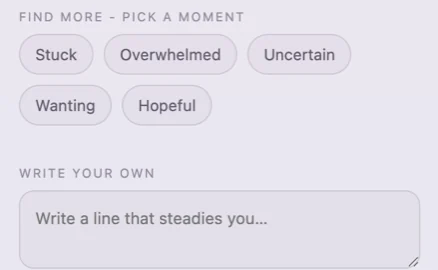
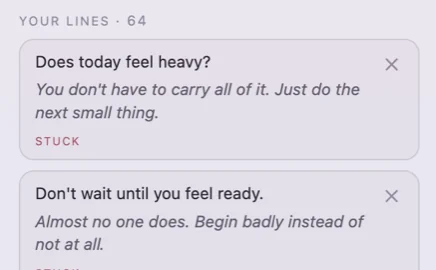
Colour carries meaning, so themes can't touch it.
Each card's colour is its register, not decoration. Themes are the monetisation test, the one plausible way this ever makes money, and they're forbidden from repainting cards. They get the companion and the settings chrome. The card is not available.
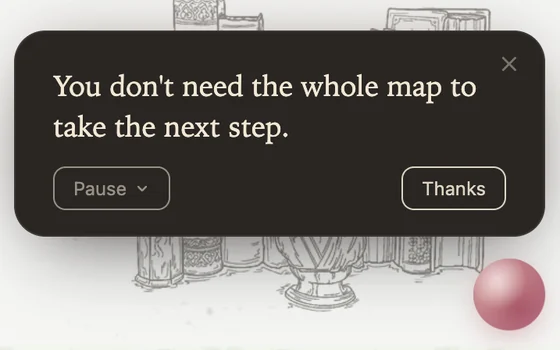
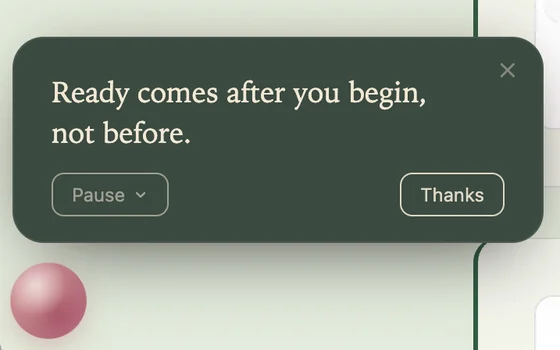
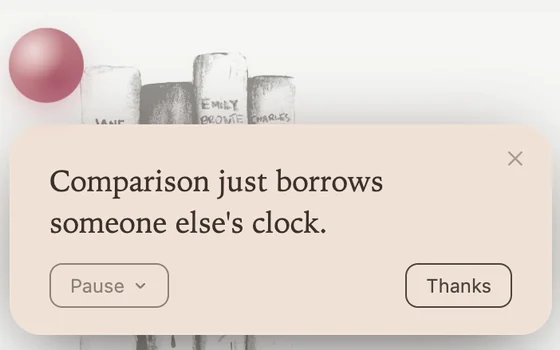
The colour is the register. Three of the five are shown rendering below.
There's a floor the settings can't override.
Fifteen minutes minimum between cards no matter what you set, and it's surfaced in the interface with its reasoning rather than enforced quietly. It's the one place I overrule the user, and saying why is the price of doing it.
Nothing is one tap from gone.
Removing a line archives it. Only the archive deletes. Deletion carries an undo, and a full reset archives rather than deletes. There's no evidence behind this one, see the audit.
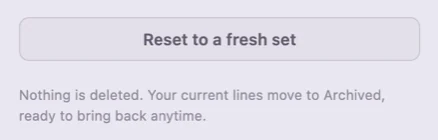
The reset archives. Only the archive deletes, and deletion carries an undo.
It's delivery, not push.
A scheduled visit isn't fired at whatever tab happens to be open. It's posted, and the first visible, focused tab claims it, so the card reaches the page you're actually looking at, and the act of switching to a tab is itself a natural pause. Visits nobody claims within five minutes lapse quietly rather than arriving late.
That last one is the decision I'm proudest of and it's invisible in every screenshot.
The tab switch does the work a notification would have interrupted.
The audit
The research and the build ran in parallel. That's the part worth saying out loud, because it decides what the audit could actually do.
Research done first is a permission slip. Research done after shipping is a defence. Done alongside, it keeps arriving for decisions that are already made and already in the product, which means every finding lands with a real cost attached, and the honest options are to change the thing or to write down that you didn't.
I checked eighteen decisions against the published evidence: eleven papers, plus a hands-on teardown of four categories of competing product. The searches were run specifically to surface evidence against the model, not to support it.
Eighteen decisions, and the one row I would point at first.
The last row is the one I'd point at. Archive instead of delete, with undo has no evidence behind it. I couldn't find a finding that argued for it and I kept it anyway, because it's a values decision. Separating the decisions the evidence supports from the decisions I made because I believe them seemed more honest than quietly filing everything under "research-led."
What the evidence said I got wrong
Four findings argued against what I'd built. Reporting them was the point of running the review.
Brains tune out repetition, and this is the big one.
ContradictedImaging studies of security warnings show the brain's response fading after as few as two exposures, with mind-wandering rising as it fades. The same wear-out shows up in cigarette warning labels and in advertising research, and the recommendation is consistent everywhere: vary the form of the message, not just its words. Solace varies its words, a sixty-line no-repeat rotation, while the orb, the bloom and the card look identical every single time. It's the main agenda item for the next version.
The corroboration is what makes it undeniable. Reviews of the mobile apps in this space repeat one line almost verbatim: the notifications become meaningless when there are so many. That's users describing, in their own words, the exact failure the neuroscience predicts. Two independent evidence streams pointing at the same flaw.
The timing has no idea what you're doing.
ComplicatedInterruptions cost far less when they arrive at a natural pause than mid-flow. My scheduler is time-based and knows nothing about the task. Partly rescued by the delivery layer, which waits to be claimed by a tab switch. But that alignment is currently incidental rather than designed, and I'd rather name it that way than claim credit for an accident.
Positive statements can backfire for the people who need them most.
Needs reviewPeople with low self-esteem who repeated self-descriptive affirmations felt worse afterwards. The statement invites an internal argument they lose. Solace is mostly protected by design here, because values-oriented lines make no claim to dispute and the lines it serves are ones the user wrote. The residual: the Affirmation register is the most self-descriptive of the five, and the starter lines that ship with it were written by me, not by the user.
And there's no efficacy evidence.
Open questionOf everything I reviewed, exactly one product has any effectiveness result attached, and even that is developer-reported. Solace has none. Every link in the chain is supported by published work; the chain itself has never been tested end to end. That's the product's central open question and it's why there's a study.
The study, and the flaw I found in it
I designed a two-part instrument to answer the four questions the audit left open: a 60-second form on install day and a four-minute form two to three weeks later.
Two of the questions appear in both forms word for word, same wording, same scale labels. The difference between the two readings is the habituation finding. One form can't produce it, because asking in week four means asking someone to recall week one through everything that happened since.
Because of that, the order isn't chronological. Install-day problems are asked about last, even though installing happened first: anything evaluative placed upstream of the repeated measure puts someone in a fault-finding frame and contaminates the baseline. Open questions come before closed ones on the same topic, for the same reason. Once you've seen a scale with "it lands less than it did" on it, you can no longer tell me unprompted what changed.
The covering note asks the people who quit to answer anyway, and says so twice. Someone who uninstalled on day three is the most informative respondent I have, and the largest threat to a study this size is that only the people who liked it reply.
I also wrote down what I cut and what each cut costs, so the choice stays visible rather than looking like an oversight.
Two identical items, three weeks apart. One form cannot produce this.
The flaw
The question carrying the most weight, did a card ever arrive just as you were about to open a feed?, is a leading counterfactual, asked by the person who made the thing, of testers who know me. It invites people to confirm my product worked.
The fix costs one field and doesn't mention Solace at all: think about the last time you opened a feed while working. What were you doing right before, and what made you stop?
The first version asks someone to validate a product. The second asks them to describe their behaviour. That's the difference between evaluative and generative work, and I'd rather show that I can tell them apart than pretend the first draft did.
What I can't claim
- There are no findings here, and I'm not going to imply otherwise.As of writing, five people have installed it and one has completed the first form. The second form doesn't fall due until two to three weeks after install. The habituation finding, the one this was all designed to produce, does not exist yet, and at this size it may end up too thin to report. I'd rather say that than dress a running study up as a finished one.
- This is self-report, not observation.I sent forms. I have not sat and watched anyone install or use it. A moderated protocol exists and hasn't run.
- The participants know me.Recruited from my own network. I was aiming for eight to twelve completed responses, which is what a study shaped like this needs to say anything at all. I'm well short of that.
- Distribution is unlisted.So nothing here is a market signal.
- The research is secondary.A targeted reading of published work plus a hands-on competitor survey, not a systematic review, and some papers were read from abstracts. Competitor data was captured in August 2026 and will go stale.
What I carry forward
I didn't research this and then build it, and I didn't build it and then justify it. The two ran together, which meant the evidence kept catching up with decisions that were already in the product. Four findings pushed back. One of them contradicted something I'd already shipped, and it's still in there.
Naming that is cheaper than defending it, and it's the only version of this story that survives someone reading the same papers I did.
"Searches run to support a product will find support. I ran mine while I was still building, so the answers could still cost me something."