Building Alex, a brand voice designed to reach copy I'd never write
The CEO and leadership wanted "powerful." I made our brand personality quietly authoritative, then built the system that carries it into copy I never touch.
Role
Product Designer & Content Strategist, sole UX writer across three lines. Content design, design systems.
Context
Accolade, 2025. B2B proptech SaaS.
Outcome
A style guide and three Claude skills, adopted and in daily use
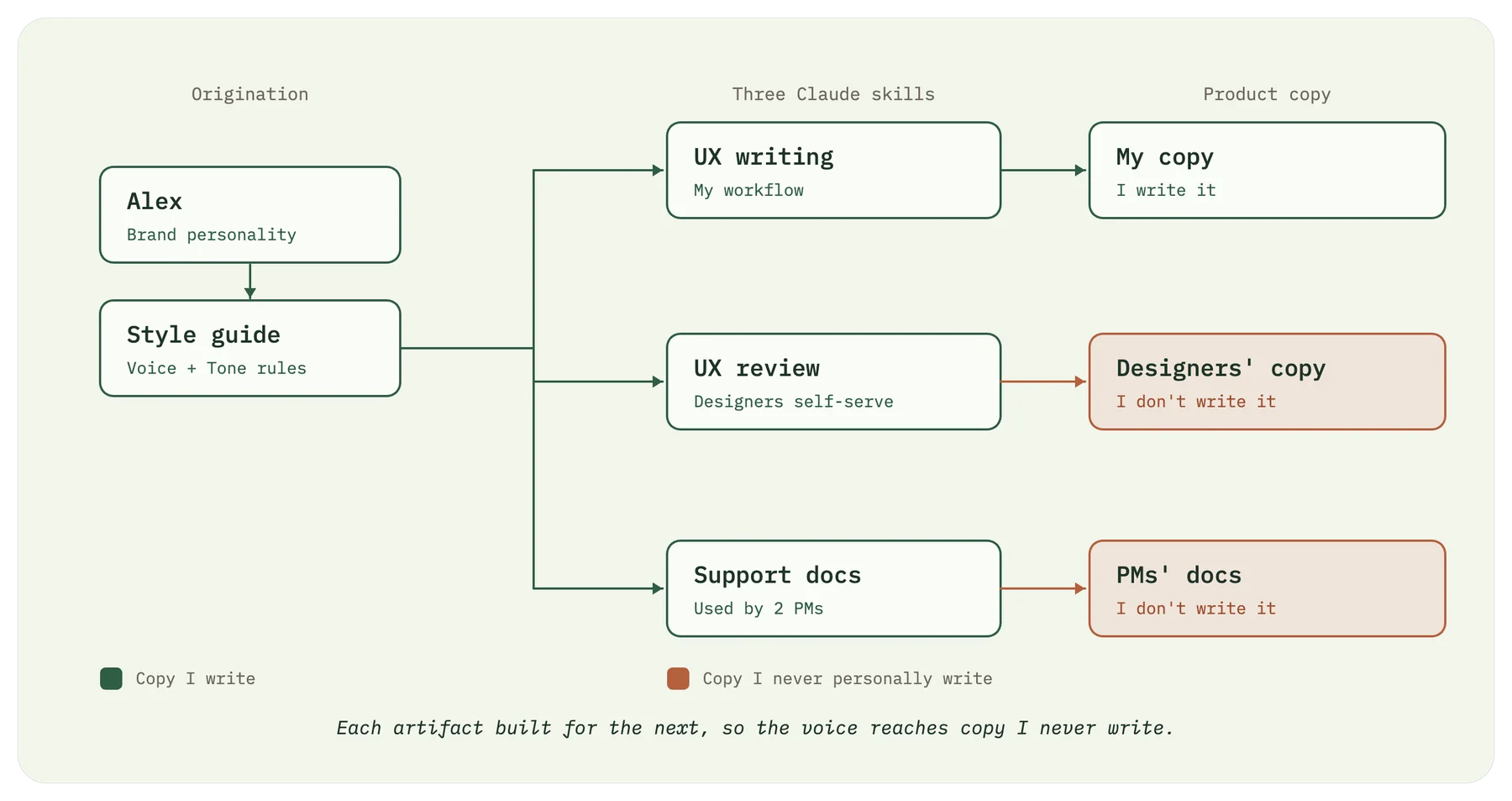
One personality, three skills, copy I never touch.
The bet
The most consequential design decision I made here wasn't a screen. It was making Alex, our brand personality, quietly authoritative instead of overtly powerful. The CEO and leadership wanted a "powerful, market leader." I read that as a register problem, not a volume problem: power isn't announced, it's embodied. Get the translation wrong and every piece of copy Accolade ships sounds off, loud where it should be calm.
The product
Accolade is a B2B SaaS platform for multifamily property operations, spanning leasing and maintenance across many communities and units. As AI-driven features moved deeper into the product, its voice became something to design, not leave to chance. For more information, see www.accoladehq.com
The chair
I came into product design through writing, so I don't treat brand voice as a document to publish. I treat it as a system to design, one that has to reach copy long after I've stopped writing it.
Context
At Accolade I was the sole UX writer across three product lines. The company had pivoted; the old marketing brand doc was thin and no longer product-relevant, and nothing coherent governed product copy. So I built the brand foundation from scratch, self-initiated, with the marketing owner's blessing.
The translation
"Powerful market leader" is an aspiration, not a spec. I translated it into a specific archetype blend, and named what I rejected:
- SageThe intelligent, trust-based guide, mapped to buyers who want operational relief.
- CreatorInnovation leadership. A market leader that redefines a category through AI is a Creator, not a Hero (achievement) or a Ruler alone (dominance).
- RulerThe CEO's "powerful," expressed as quiet authority: embodied through structure, not announced.
I grounded it rather than trusting taste: I triangulated the blend across three frameworks, Jung archetypes, Gobé's emotional branding, and Aaker's brand-personality model, and they converged on the same figure, the wise builder, quietly authoritative. I also archetyped the competitor as a Caregiver, the helpful servant, and positioned Alex deliberately opposite: a leader, not a helper. That's why "market leader" became quiet authority.
The system, where this stops being a doc
Alex wasn't an endpoint. I built the personality for the style guide; I built the style guide to feed three Claude skills: my own writing, a self-serve review skill designers use when I'm out, and a support-docs skill two PMs use. So Alex reaches product copy through three channels, including copy I never personally write.
The clearest proof: I compiled Alex into a copy-review rubric, competence, sophistication, creator-energy, sincerity, each with concrete rules, that runs inside the review skill. The personality became machine-runnable governance.
Alex, compiled into machine-runnable governance.
Where the personality actually lives
Auditing my own work taught me this: at the copy level, brand voice and good UX writing look identical, so a brand voice "defended" in the words is no defense at all. Alex shows up one layer above the copy, in which pattern I reach for when a decision could go several ways.
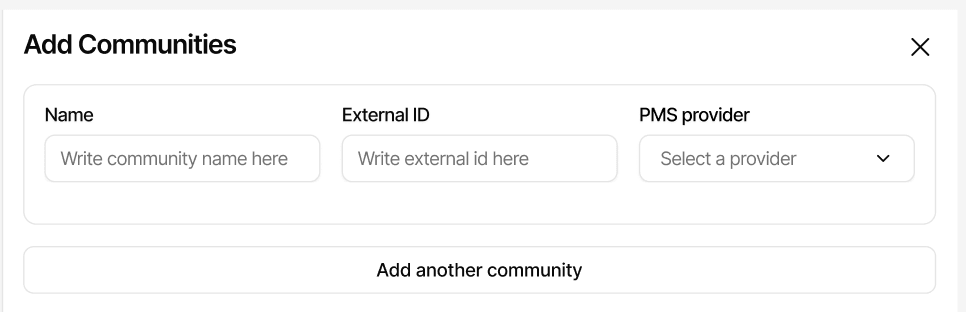
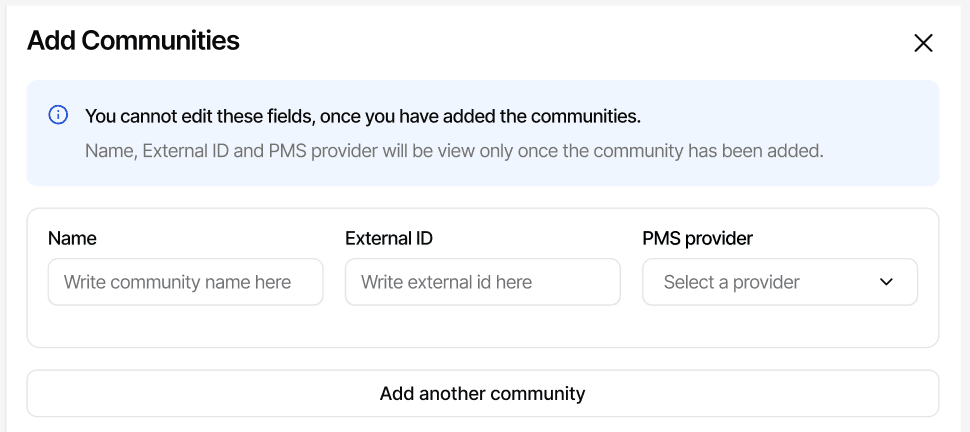
- Add Communities · a proactive, Sage-driven info banner ("these fields become read-only once the community is added") instead of letting users hit an error after they submit. The informed guide who tells you what to expect before you commit.
- Delete Community · the Ruler-hint call. I chose type-to-confirm friction from the space of destructive-action patterns (checkbox, undo, modal, type-to-confirm), because authority is embodied through structure. I made the pattern decision from the archetype; another designer implemented the specific UI in their feature.
Add Communities · Sage in practice
Outcome
The style guide and the three skills are adopted and in daily use, that part is real. What I won't claim: I haven't validated that the archetype blend lands as intended, no user testing, no independent trait-recognition study. So I'll say precisely what's true: the distribution system works and is used; the personality's effect on how copy is perceived is designed and grounded in three frameworks, but not yet measured.
What I carry forward
I don't build a personality as an endpoint, I build it for the style guide; I don't build the style guide as a reference, I build it to feed the tooling that carries the voice into copy I'll never touch. That's not a step I remember to add. It's how I build now.
"Brand voice work stopped being doc-writing for me and became distribution architecture."